Emergency Water Removal in North Willow Farms: Response and Pricing
When water is rising in your North Willow Farms home at midnight, you are not browsing for articles. You are scanning for a phone number and a price range you can trust. This page is built for that moment. North Willow Farms Water Restoration has handled emergency water removal across Central Indiana since 2018, and we have learned that the homeowners who recover fastest are the ones who understand two things before they hire anyone: what response time actually means, and what the pricing reflects.
There is a wide gap between a company that says they are available 24 7 and one that has a technician with a truck mount extractor pulling into your driveway in under an hour. There is also a wide gap between a $1,200 invoice and an $8,000 invoice, and that gap is rarely about who is overcharging. It is about water category, square footage affected, how long the water sat, and what materials it touched. Below you will find a single deep comparison built from real North Willow Farms jobs, paired with the analysis you need to make a fast, informed call. If we cannot help with your specific situation, we will tell you directly and point you toward someone who can.
What a Real Emergency Response Looks Like in North Willow Farms
When water is actively spreading across a finished floor, response time is not a marketing number, it is the entire job. A reasonable target for emergency water removal in North Willow Farms is a live human answering the phone within a minute or two and a truck rolling toward your address inside the next thirty. From most parts of central Indiana, North Willow Farms Water Restoration aims for an on site arrival inside sixty to ninety minutes of the call, and faster when crews are already staged nearby. The IICRC guidelines we follow treat the first 24 to 48 hours as the window where Category 1 clean water can degrade into Category 2 gray water, and where mold spores begin colonizing organic materials. That is not a scare tactic, it is the physical reality of how cellulose, gypsum, and wood behave once they pass roughly 16 percent moisture content.
When the crew arrives, the first ten minutes are not about pulling equipment off the truck. They are about finding the source, stopping the flow if it is still active, and documenting everything with moisture meters and photos. That documentation is what your insurance company will ask for later, and it is the single biggest reason homeowners get full reimbursement instead of partial. If you want to understand the paperwork side before the adjuster calls, our walkthrough on filing a water damage insurance claim covers the language carriers expect to see on a scope.
What separates a competent emergency response from a chaotic one is sequence. After the source is isolated and the scene is documented, the crew maps the migration of the water using thermal imaging and pinless meters, because what you see on the surface is rarely the full extent of the loss. Water travels along the path of least resistance, which usually means down a wall cavity, under a baseboard, into a subfloor seam, and across a joist bay until it hits a low spot you cannot see from the room above. A bathroom leak on the second floor of a North Willow Farms home can easily show up as a ceiling stain in the living room, a damp pad under the dining room carpet, and elevated humidity in a finished basement, all from the same fifteen minute supply line failure. Skipping the mapping step is how restoration jobs turn into mold remediation jobs three weeks later.
How Emergency Water Removal Pricing Actually Works
Pricing is where most companies in this industry get vague, and where homeowners get burned. Here is how a fair quote gets built. Emergency water extraction in North Willow Farms typically runs between 3 and 7 dollars per square foot for the affected area, depending on the category of water, how saturated the materials are, and how much of it has migrated into wall cavities or under cabinets. A small bathroom overflow caught quickly might cost 800 to 1,500 dollars to extract and dry. A finished basement with two inches standing across 600 square feet generally lands between 3,500 and 7,500 dollars by the time extraction, antimicrobial treatment, demolition of unsalvageable material, and three to five days of drying with air movers and dehumidifiers are complete. Category 3 water, meaning sewage or floodwater carrying contaminants, runs higher because of the protective equipment, disposal fees, and additional sanitation cycles required. Our explainer on why sewage backup is a Category 3 emergency breaks down why those jobs cost more and why cutting corners is genuinely dangerous.
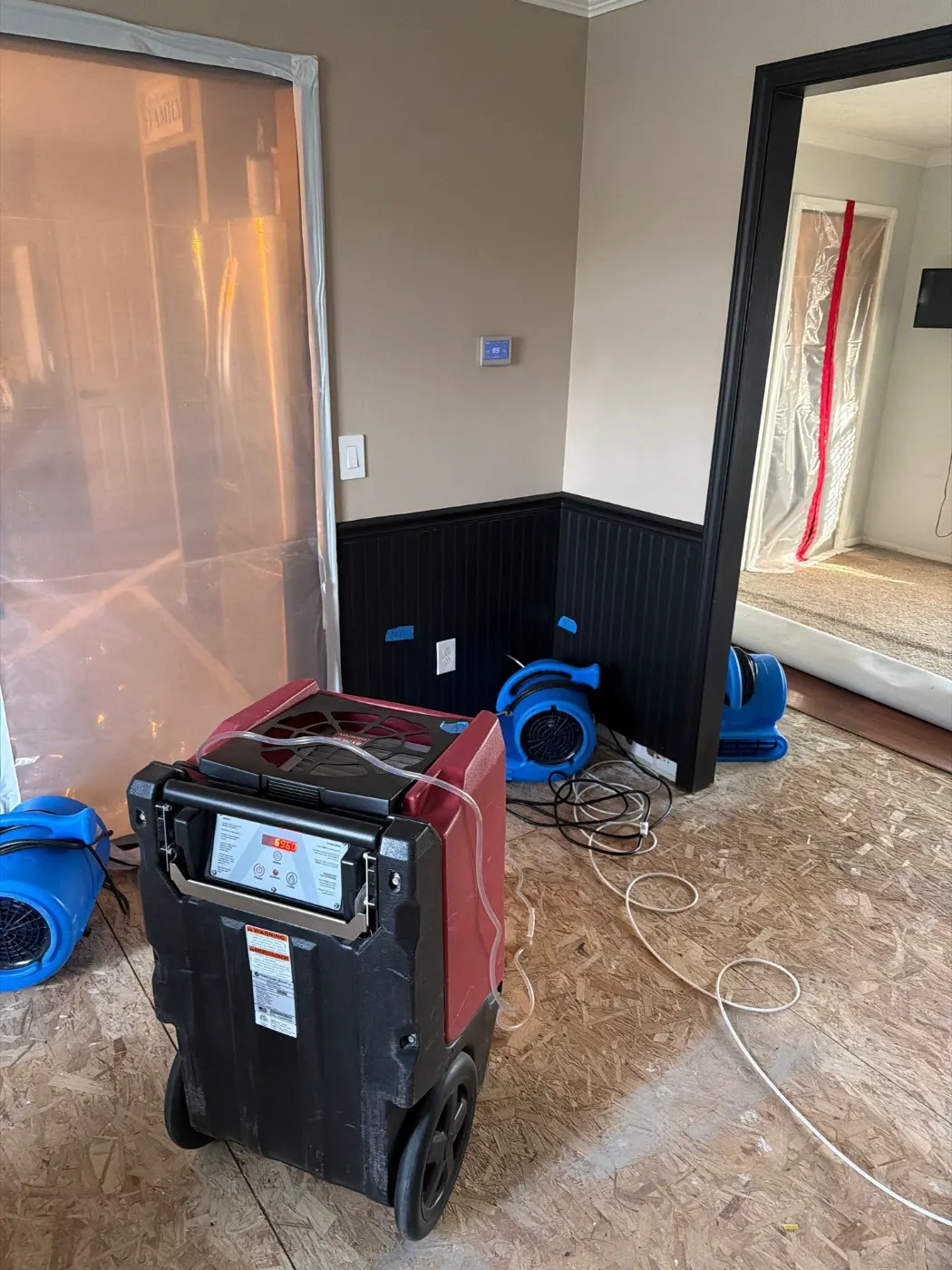
The drying phase is where homeowners sometimes feel the bill grow, and it helps to know why. Each air mover rents at roughly 25 to 35 dollars per day, each dehumidifier between 75 and 125 dollars per day, and a typical loss needs four to ten air movers and one or two commercial dehumidifiers for three to five days. That equipment math is what drives the back half of the invoice. Reputable contractors document moisture readings every 24 hours and pull the equipment the moment materials hit dry standard, not a day later. If anyone tells you the equipment has to run for two weeks without showing you readings, get a second opinion.
There are also line items that legitimately raise a quote and should not surprise you when explained up front. Containment plastic and zipper doors run a few hundred dollars when the affected area needs to be isolated from the rest of the home to protect indoor air quality. Hardwood floor drying systems, which use mat panels and specialized dehumidifiers to pull moisture out from below the finish, can add 1,500 to 3,500 dollars but often save a floor that would otherwise cost three times that to replace. Content manipulation, meaning the labor to move and protect furniture, electronics, and personal belongings, is typically billed hourly and should appear as its own line. When you see those items broken out clearly on a North Willow Farms Water Restoration estimate, that is a sign the scope was built honestly rather than padded with vague fees.
What You Can Do in the First Hour Before the Truck Arrives
While you are waiting on the crew, a few small actions make a measurable difference in the final cost. Shut the water at the main if the source has not stopped on its own. Kill the breaker to any room with standing water before stepping in. Lift drapes, move furniture legs onto foil or wood blocks, and pull up loose area rugs so they do not bleed dye into the carpet underneath. Do not run a household shop vac on anything deeper than a quarter inch, and do not start tearing out drywall before the technician documents the original condition for insurance. We put together a fuller checklist in our guide on the first steps after water damage that homeowners in North Willow Farms can pull up on a phone while they wait.
One thing worth saying clearly. Pricing depends on what the crew actually finds, not what gets described over the phone. A good restoration company will give you a ballpark range during the call, then a written scope after the on site inspection, then a final invoice that matches the scope unless something hidden comes to light, in which case you get a change order in writing before the work happens. That sequence is non negotiable at North Willow Farms Water Restoration, and it should be non negotiable at any IICRC certified company you hire in central Indiana. If a contractor refuses to put numbers in writing or pressures you to sign a blanket authorization before scoping the loss, that is the moment to call someone else.
Insurance handling is the last piece worth mentioning before you call. Most homeowners policies in Indiana cover sudden and accidental water damage from internal plumbing, water heaters, and appliance failures, but they often exclude groundwater intrusion, slow leaks that went unnoticed, and certain sewer backups unless a specific endorsement was added. We bill the carrier directly when coverage is confirmed, walk you through your deductible, and only ask you to commit out of pocket for items the policy will not touch. If your claim is denied or underpaid, we provide the moisture logs, photo documentation, and scope notes you need to appeal, because the paperwork from day one is what carries the argument later.
Get Water Out, Get Answers, Get Back to Normal
Emergency water removal is not the time to shop five quotes. It is the time to call a certified local crew that will arrive fast, price the work honestly, and document everything for your insurance. North Willow Farms Water Restoration has served North Willow Farms property owners since 2018 with that exact approach. Call us now for immediate response, or read more on our water damage restoration service page to see the full scope of what we handle.
Frequently Asked Questions
How fast can North Willow Farms Water Restoration arrive for emergency water removal in North Willow Farms?
Our standard emergency response window for North Willow Farms and surrounding central Indiana communities is 45 to 90 minutes, 24 hours a day. Dispatch confirms ETA on your initial call.
What does emergency water extraction cost in North Willow Farms?
Extraction runs $1.50 to $4.00 per square foot in North Willow Farms, depending on water category and depth. North Willow Farms Water Restoration provides a written estimate before any work begins, and most jobs are covered by homeowners insurance minus your deductible.
Will my insurance pay for North Willow Farms Water Restoration services?
Most policies cover sudden and accidental water damage. North Willow Farms Water Restoration bills your carrier directly, documents every step with moisture readings and photos, and works with your adjuster so you only pay your deductible in most North Willow Farms claims.
How long does structural drying actually take?
Typical North Willow Farms residential drying takes 3 to 5 days with proper equipment placement. Slab foundations, hardwood, and dense materials may extend to 7 days. We monitor daily and remove equipment only when materials reach pre-loss dry standard.
What is the difference between Category 1, 2, and 3 water?
Category 1 is clean supply line water. Category 2 is gray water from appliances or toilet overflow without solids. Category 3 is black water including sewage, flood water, or any source carrying pathogens. Category 3 requires removal of porous materials and full antimicrobial treatment.
Have a restoration question?
Our IICRC certified North Willow Farms crew is ready to help. Free assessments, estimate based on what we can sees, no pressure.